
Sophie Mills
The Image of Classics and Classicists in Modern Fiction: Seducers, Slayers, and Survivors
From monopoly to royalty to option to cut: Classics is a discipline like no other.
From a detailed study of novels portraying Classics and classicists over the last century and a half, I have outlined certain prevalent tropes which strongly shape how the discipline and its practitioners are portrayed in fiction.
For example, fictional Classics teachers tend to be elderly – naturally, since the material they study is ancient – and they often foreground ending, death or decline: where a novel mentions a Latin program, it is probably in danger of being abolished. On the other hand, the immense influence of the discipline over hundreds of years can save it from literal death, because the authority of Classics on European tradition cannot easily be exterminated. In a significant number of narratives, what seems moribund proves joyously resurgent in the end.
Second, because Classics focuses on the ancient world, it is automatically opposed to the “real” modern world, especially that of science, technology or business. But that “real” world often turns out to be grubby or disappointing compared with the classical world, whether it is imagined simply as a different world or as an ideal. In particular, the classical is imagined as a kind of virtual world which its practitioners either seek to recreate in their own image or use as a source of examples, often through quotations or models, for guiding their own conduct in the world. The former is typical of fictional archaeologists, the latter of literary classicists. Either way, classical knowledge is used to exert control over the world, and to offer classicists a particular identity, which sometimes emboldens them to assume a mastery beyond the objects of their own expertise.
By definition, this kind of knowledge does not belong to everyone, and a third major tendency in classical fiction is the distinction between the classical initiated and the lowly uninitiated. Though it runs through the full 150 years that this book discusses, this opposition is expressed in two distinct ways, related to bigger educational landscapes. In earlier novels, being initiated is a clubby affair, part of the comfortable world of chaps, full of familiar tags and references that “everyone” broadly understands. By the last few decades, however, Classics has become so rare in the educational landscape that it is portrayed as exotic and seductive, and uniquely capable of leading its adherents towards disaster, often under the influence of more violent moments in the classical canon.
Classics is imagined as intellectually seductive a century before the publication of Donna Tartt’s famous novel The Secret History (1992) in Thomas Hardy’s portrayal of Jude Fawley’s passionate longing for Classics and Oxford. Though Jude is partly seeking social advancement, his longing is born of an intense intellectual affinity with the actual subject. Yet in some earlier novels, the seduction of classical material is in notable tension with classroom Classics, expounded by traditional pedagogues who are dull, frightening or both. An element of dry memorization and a willingness to surrender to mastering rules thousands of years old may ultimately be unavoidable in learning Latin and Greek, and older novels often portray Classics teachers as rigid and authoritarian, though the tendency recedes somewhat in more contemporary novels as we have had to mend our ways.
Because Classics is associated with the ancient world, it can also be associated with other, magical or mysterious worlds. Similarly, Classicists are good at solving mysteries, because they are trained to pursue and interpret minutiae. Especially in novels set in schools, sexuality is another important trope, and popular images of Greece, combined with the familiar use of Classics as a storehouse of examples, underpin fictions in which same-sex relationships are inspired by ancient ideals.
Ongoing thread. More from Sophie Mills to follow.
Curator: Bora Pajo
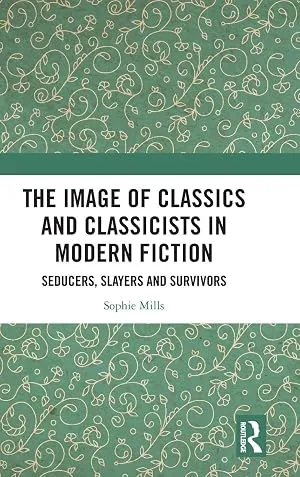
The Image of Classics and Classicists in Modern Fiction: Seducers, Slayers, and Survivors
Mills, S. (2026). The image of classics and classicists in modern fiction: Seducers, slayers, and survivors. Routledge.
Available here →November 11, 2026
20261111-mills-the-image-of-classics-and-classicists-in-modern-fiction-the-wide-angle
The wide angle
The rest of this thread
This is a proposed thread.

Sophie Mills
Sophie Mills is an award-winning teacher of Greek and Roman literature who has taught at UNC Asheville for over 30 years. She works on Greek tragedy, especially Euripides, Athenian imperialism, and has an abiding interest in classical reception – how literature 2700 years old continues to shape and be shaped by contemporary culture. Her most recent book is The Image of Classics and Classicists in Modern Fiction: Seducers, Slayers, and Survivors (Routledge, 2026).
Pull this thread
Modern fiction keeps alive an elitist image of Classics that real Classics departments have worked to leave behind.
More in Books
Know something the rest of us don't?
Most threads on Rorotoko begin with our invitation. Any thread can begin with a proposal: you write it with the same prompts every thread answers, and we review it.
Propose a thread →